
Maker record
Wesa
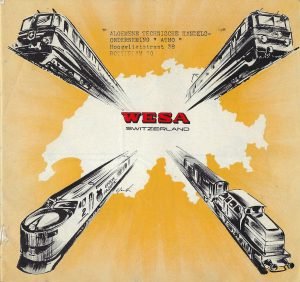
WESA was a Swiss maker of compact electric model railways, founded in Inkwil in 1945. Its 13 mm gauge track allowed layouts to fit on a table, and its first trains were sold as WESA-Liliput, then among the smallest commercial model railways. Early rolling stock included wooden-bodied vehicles; from 1947, plastic moulding enabled finer parts and a wider range of Swiss prototype locomotives and cars. WESA locomotives used die-cast zinc bodies, and the company exported a substantial share of its production.
- Founded
- 1945
- Final year
- 1985
- Countries
- Switzerland
- Locations
- Inkwil, Switzerland · 1945
- Founders
- Hans Sandmeier
The story of Wesa
During the Second World War, technical officer Hans Sandmeier designed a compact electric railway with tight track curves suitable for a table layout. The resulting WESA-Liliput used 13 mm gauge track and an initial scale of about 1:110; later vehicles were made at roughly 1:100. Sandmeier founded the company after the war and moved into a factory building he had bought in Inkwil, canton of Bern, on 1 August 1945. The first 500 train sets reached retailers for Christmas that year, despite postwar material shortages.
Early track used metal rail profiles on wooden roadbed, later replaced by nickel-plated brass and plastic components, including a track with a plastic sleeper strip. Initial passenger cars were milled from solid wood and covered with printed paper. From 1947, plastic moulding made finer parts possible and the range expanded to include more realistic Swiss locomotives such as the Re 4/4 and Ae 6/6. WESA locomotives had die-cast zinc bodies. The company exported widely, with exports reported to account for as much as 70 percent of production.
Competition from H0 railways weakened the appeal of WESA’s unusually small gauge. The founding company stopped production in 1966 as it changed direction. E. Aerni of Wimmis then took over assembly and distribution, but ended that work in 1967 amid increasing foreign competition. Later successors handled the brand, without restoring production on a comparable scale.