Maker record
Trix Twin Railways (TTR)
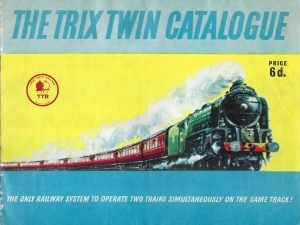
Trix Twin Railway (TTR) was a British model railway range introduced in 1935, with trains, rolling stock and trackside accessories in 00 gauge. Its three-rail track allowed two locomotives to run independently on the same layout, using the outer rails for separate power feeds and the centre rail as common return. Early mechanisms were made in Germany while British-outline bodies were made in the United Kingdom; production shifted increasingly to Britain before the Second World War. After resuming in 1948, the range moved from AC to DC operation and later from three-rail to two-rail track.
- Founded
- 1935
- Countries
- United Kingdom
- Locations
- Northampton, UK
- Founders
- Stephan Bing · Fritz Bing
The story of Trix Twin Railways (TTR)
Trix electric trains were first made in Germany in 1935 as Trix Express and reached Britain that Christmas. Bassett-Lowke distributed the imported sets as the Bassett-Lowke Twin-Train Table Railway. The British range grew from this German-made system: in 1937, English-made locomotive body castings introduced British designs, alongside rolling stock in the liveries of the LNER, LMS and Southern Railway. Its three-rail track used a common centre rail and separate outer rails, allowing two locomotives to be controlled independently on one layout.
The British Trix company was established by Stefan Bing, who had left the German Bing company and moved to Britain as Nazi influence increased. Early mechanisms came from Germany while British-outline bodies were made in Britain; manufacture shifted progressively to British factories as relations between the countries worsened. Production was interrupted during the Second World War and resumed in 1948. Postwar products included British Railways liveried locomotives and coaches, American-outline locomotives for export, and stations, signals and other layout accessories.
Trix changed to 12-volt DC operation in 1956 while retaining three-rail track. In the mid-1960s, plastic increasingly replaced diecast metal and tinplate, and two-rail track replaced the three-rail system in 1967; three-rail products remained available to special order until 1972. The models later appeared under names including Trix Trains, British Trix and Liliput. Production under the Trix and Liliput names ceased in the 1970s, while some former British Trix tooling was later used by Dapol and Bachmann.