


Maker record
Liebmann/Stadtilm
East German producer of O and S gauge trains.
- Founded
- 1938
- Final year
- 1964
- Locations
- Stadtilm, Germany
- Founders
- Carl Liebmann
The story of Liebmann/Stadtilm
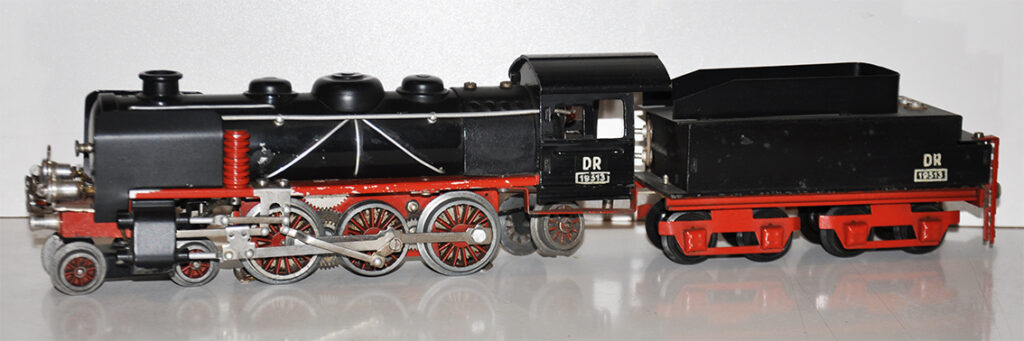
Carl Liebmann founded the Carl Liebmann Metallwerke company in Stadtilm in Thuringia around 1938 with the intention to produce an 0 gauge model of the famous Fliegender Hamburger (Flying Hamburger). Following the outbreak of war, his company produced parts for the German airforce however, but in 1945 he resumed his efforts to make an 0 gauge train and began production of the Flying Hamburger railcar, designed in 1938. The body was made of aluminium and this material was chosen for locomotives, rolling stock and also the three-rail track. The trains were modeled after those of the Deutsche Reichsbahn (DR). Other models were a cab locomotive called the "Bulli-Lok" and a simple but well-proportioned 0-4-0 steam locomotive with tender. All locos and rolling stock had an enamel paint finish with decal lettering, sprung buffers, and compact hook couplings that resulted in relatively small gaps between cars. The model track, with its large radii, had low profile rails and seven or nine sleepers per length. All locomotives were equipped with 24V DC motors for three-rail operation.
In 1951 Liebmann was nationalized and became "VEB Metallspielwarenfabrik Stadtilm Thüringen" (VEB Stadtilm Metal Toy Factory, Thuringia). Trains and packaging were branded "Stadtilmer Bahnen" (Stadtilm Railways). At the end of 1952, Carl Liebmann and his family fled to West Germany.
In 1955 Stadtilm sold its 0 gauge production to Zeuke & Wegwerth and concentrated on a new S gauge system with prototypical two-rail operation. The locomotive bodies were of injection-molded plastic, the chassis were of metal. The freight and passenger cars were predominantly made of sheet metal. The locomotives were made with a 12-volt DC motor powered by a transformer or with a 4.5-volt motor powered by a flat battery. Production of the S gauge trains ended in 1964.